Showing posts with label classic ideas. Show all posts

Tuesday, October 5, 2021

Super-Important Thoughts About Foundation So Far


This is not Isaac Asimov's Foundation. 

That's not necessarily a bad thing. The original trilogy is clunky. Most of it is characters plotting at one another in rooms of different sizes: Courtrooms, boardrooms, groundcars, abandoned factories, starship cockpits, hotel rooms, apartments. It's often hard to conjure up an image of what's happening, because Asimov provides so little descriptive detail. Until Foundation and Empire, its characters are mostly default white guys. Asimov's prose is workmanlike, but nothing exceptional (although he does have a gift for the occasional character detail - the "pudgy hands" of a man feigning murderous outrage, for instance).

So why is the trilogy considered a masterpiece? 

1. It starts with a grand idea, and sticks with it. For the first one and a half novels, everything is about how Seldon's Plan works out its psychohistorical necessity. In the second half, everything is about restoring the plan after it's fractured by a literally unforeseeable event.

2. It works beautifully in terms of the nuts and bolts of craft. There are no idle characters or story elements in these books: Every character has a purpose, and they work ruthlessly toward it without hesitating or whining or pondering their place in the cosmos. If you're looking for stories that drive forward like clockwork, Foundation is your SF go-to.

 3. It conveys a sense of historical time. Better, it has the audacity to try to convey a sense of historical time.  

So far, AppleTV's Foundation is none of this.

Positives: When it comes to lush physicality, Asimov was lacking, but the TV series is not. In fact, the opening episodes are the most gorgeous SF I've seen on TV in...maybe ever. The decadence of the Empire is laid out on the screen in saturated red, blue, and black with glittering gold and silver highlights. Architecture overwhelms people. Every space, every costume, is crammed with detail. It has grandeur. Also, the people of the Empire are all the colors of the rainbow, and not uniformly male.There are some interesting ideas that could have been the bases of their own series [like the "genetic dynasty" of the Cleons].

BUT...

The TV series seems to have abandoned the fundamental rules of psychohistory...and those are the core of the trilogy. Real quickly, here they are:

1. Psychohistory can predict the future, but only the futures of large groups, like nations, empires, planets, or galaxies. The larger the group, the more accurate the prediction.

2. Psychohistorical predictions don't work if those groups are aware of the laws of psychohistory or the predictions themselves.

3. As a corollary of #1, the actions of individuals almost never have much impact on major events. The best they can do is facilitate matters that are already inevitable. 

Anyone who has tried to write a story can see the trouble with these laws when it comes to narrative: If a character's actions don't matter in the grand scheme, why should a reader care? Asimov finessed the problem with stories in which the protagonists had foreground goals, while larger events took place in the background; with stories in which the characters' actions were full of derring-do but proved fruitless; with stories in which the characters take decisive action while fretting about the consequences of knowing too much about the future; with stories...well, you get the idea. He was brilliant at squaring the circle, and that's part of the fun of the trilogy.

The TV writers are less audacious, less interested in the idea, and more driven by Hollywood tropes that have been used a lot. In the TV version, psychohistory has devolved from a mathematical tool to an oracular power, a magical way of predicting the future. There is still lip service paid to the idea of math, but characters "see" the future basically by staring into a cloud of light motes which is meant to represent a mathematical display. [In the books, this "Prime Radiant" is just a convenient way of portraying complex formulae, the 20th century foreshadowing of a PowerPoint deck; on the TV show, it's portrayed as a semi-magical scrying device that can only rarely be activated except by those who are worthy.] At one point one character activates the display and asks her daughter if she can understand it. The daughter says "no," but this should never have even been a question: At least in theory, anyone with sufficient mathematical training should be able to figure it out, and no one without training should be able to. It's math, not magic; you shouldn't have to be a Chosen One to make it work...but you can see the Chosen One trope tugging at the writers' subconscious all the time.

They've also taken one of my favorite characters and changed him from a cigar-chewing pacifist politician based on Fiorello LaGuardia to a moody young "warden" with an enormous gun who knows she is "different" from the other settlers. Sure, not a Chosen One at all.

The series has not veered irreparably away from the Seldon Plan yet. But the primary indices don't look great.

Saturday, April 15, 2017

That Guy on Guns

A lot of folks know Robert Heinlein as one of the Big Names of the Golden Age of Science Fiction - from the 1930s to the 1950s. Some folks know his later, creepier stuff. And every Randian Objectivist nerdbro knows him as the guy who articulated their anarcho-libertarian power fantasies better than they ever could, from TANSTAAFL ("there ain't no such thing as a free lunch") to his famous [or infamous] dictum on guns: An armed society is a polite society. 

That's a quote from one of Heinlein's pulpier works, Beyond This Horizon, in 1942. It's gained enormous currency among gun enthusiasts since then, because it brilliantly encapsulates what might seem to be an obvious train of thought: People won't gratuitously insult, assault, or cheat someone who can kill them.

And that's too bad, for a couple of reasons.

Thursday, May 9, 2013

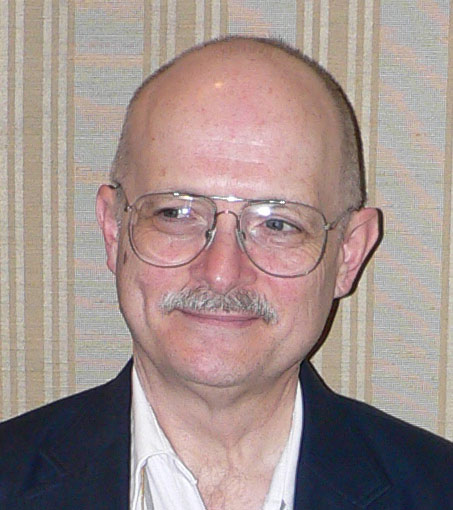
I Wish Vernor Vinge Weren't So Freaking Smart

Some of you may remember how I've hyped Doc Vinge in the past. The man who predicted the Singularity (which allowed Ray Kurzweil to become king of the celebrinerds) and got to cyberspace before Gibson.

Well, my favorite Vinge work is A Deepness in the Sky, which contains half a dozen mind-blowing concepts, some of them utterly terrifying. One of the creepiest is the "Larsen localizers," the great-great-grandchildren of RFID chips: dust mote-sized computers that individually contain a tiny bit of sensing and processing power, but together form into an immensely powerful network that can monitor virtually everything that happens in the localizers' covered area. This leads to "ubiquitous law enforcement" - tyrannies that make Big Brother look like Ron Paul.

Well, guess who's working on Larsen localizers now, 14 years after ADITS came out? Just about everybody. Here's the original announcement.

Sunday, October 7, 2012

Particle AND Wave

A little complementarity on Niels Bohr's birthday...


The walls between science fiction and fantasy are breaking down. Back in the day, it was either Tolkien or Heinlein. Not only was fantasy non-technological, it was almost always pre-technological. Horses, not cars; swords, not guns. Even fantasy ostensibly set in the modern world would often wend its way to a secondary world - through a wardrobe, for instance - where technology simply wasn't.

Then came wainscoting (which I've mentioned before) where magic does exist in the here and now, but is carefully hidden away from ordinary muggles...er, mortals. Obviously, the magic's hidden away in Harry Potter, but Rowling was far from the first to use the wainscot. Any pre-True Blood vampire story, for instance, has the undead hidden away. The Borrowers is classic wainscot. [Decades later, wainscoting is still going strong. Percy Jackson, Neverwhere, Highlander. Tim Powers turned history into wainscot fantasy with masterpieces like The Stress of Her Regard and On Stranger Tides.]  Fantasy and science fiction edged closer and closer. 

And then came the '60s. "Any sufficiently advanced technology is indistinguishable from magic," said Arthur C. Clarke. And in the '60s, writers like Michael Moorcock and Jack Chalker took him at his word, creating futures whose inhabitants no longer understood the forces that gave them their magical powers. But there was one writer who followed that avenue while delineating the philosophical difference: Roger Zelazny.

He created worlds full of characters who were literally deii ex machina - people with godlike powers granted by technology; so godlike, in fact, that they assumed the identities of the Hindu, Egyptian (and even alien) pantheons. But even while he was doing this, Roger never lost sight of the border:

"It is the difference between the unknown and the unknowable, between science and fantasy – it is a matter of essence. The four points of the compass be logic, knowledge, wisdom and the unknown. Some do bow in that final direction. Others advance upon it. To bow before the one is to lose sight of the three. I may submit to the unknown, but never to the unknowable. The man who bows in that final direction is either a saint or a fool."  (Lord of Light)

Science and magic, SF and fantasy, reason and the unknowable, particle and wave - complementarity. The next big step in fantasy is bridging the gap, writing science and magic in the same story at the same time.

Tuesday, August 21, 2012

Classic F/SF Ideas: Franchise Government

A social system in which governmental functions like security, defense, and conflict resolution are maintained by private organizations, not public bodies; or a society in which the government no longer has a "monopoly of legitimate violence" - especially if some or all of those functions have been assumed by corporations. Derived from anarchist political theory, it is also a defining concept of cyberpunk and other forms of dystopian science fiction.

"The Ungoverned," Vernor Vinge
Snowcrash, Neal Stephenson

Tuesday, July 31, 2012

Classic Ideas in Fantasy and Science Fiction: First Contact

The biggie. The most important trope in science fiction...after guys in red shirts getting killed, of course. E.T., War of the Worlds, Close Encounters, Contact, Star Trek XXXIV, and on and on.

The Mote in God’s Eye, Larry Niven and Jerry Pournelle
"A Martian Odyssey," Stanley G. Weinbaum
“First Contact,” Murray Leinster
"The Helping Hand," Poul Anderson
The Martian Chronicles, Ray Bradbury
2001, A Space Odyssey, film, Stanley Kubrick and Arthur C. Clarke
Close Encounters of the Third Kind, film, Steven Spielberg
The Day the Earth Stood Still, film, 1951, Robert Wise, Harry Bates, Edmund North
ET, film, Steven Spielberg
The Man Who Fell to Earth, film, Walter Tevis, Nicolas Roeg
Solaris, Stanislaw Lem
Contact, Carl Sagan
Similarly:
A Signal From Space, Will Eisner (graphic novel)
His Master's Voice, Stanislaw Lem
The Hercules Text, Jack McDevitt


Sunday, June 17, 2012

Classic F/SF Ideas: Exoskeleton Suits

It's armor...that makes you stronger! Super-cool, neh?
But before Halo, anime and manga, there were these folks:

The Forever War, Robert Haldeman
Starship Troopers, Robert Heinlein
Iron Man, comic, Stan Lee & Larry Leiber

Although Heinlein's novel came first (he has so many firsts!) and has one of the most exciting descriptions of future warfare ever in the first chapter, Haldeman's novel is more realistic, grimmer, and in general (I think) a better effort. As a side note - Heinlein served five years active duty in the Navy, but tuberculosis invalided him out in 1934. Haldeman was a draftee who served as a combat engineer in Vietnam, where he was wounded. You can see their backgrounds in the books: Heinlein, the man who wanted to serve, pre WW2, but ultimately didn't experience combat; and Haldeman, the man who didn't want to be there in Vietnam but did experience combat, whether he wanted to or not.

Friday, April 13, 2012

Classic F/SF Ideas: The Nature of Reality

Epistemology/Hallucination/Enlightenment/The Nature of Reality

Science fiction is the ideal genre to deal with philosophical questions. And we don't think small...

Ubik & A Scanner Darkly, Philip K. Dick
The Futurological Congress, Stanislaw Lem
"An Occurrence at Owl Creek Bridge," Ambrose Bierce

Thursday, April 5, 2012

Classic F/SF Ideas: Enigma Tales

We are confronted with artifacts we do not understand, from a race or culture that's not around to tell us what it all means. Sometimes it's a human culture; sometimes it's alien. Enigma tales often involve the promise of great wealth to lure the main characters into action, and the puzzles can be the author's way to illuminate the characters confronting them. Some have argued that, since SF is the literature of "What If?" Enigma Tales represent one of the purest expressions of the genre.

Rogue Moon, Algis Budrys
Gateway, Fredrick Pohl
"Ticket to Anywhere," Damon Knight
"By The Waters of Babylon," Stephen Vincent Benét
“Mimsy Were the Borogoves,” Henry Kuttner and C.L. Moore (writing as Lewis Padgett)
Forbidden Planet, film, Irving Block, Allen Adler, Cyril Hume, Fred M. Wilcox
Solaris, Stanislaw Lem

Saturday, March 17, 2012

I know we're mostly about the "F" in "F/SF," but-

-you have to check out this orbital delivery system at io9.com.

Pay attention to the economics projections. How cool is that?

(Of course, Heinlein predicted a railgun delivery system 70 years ago in The Man Who Sold the Moon.)

Tuesday, March 6, 2012

Classic F/SF Ideas: The Decadent Earth

The Decadent Earth

A post-Imperial planet or civilization whose citizens live among the remnants of a glorious past. In some novels, it can be seen as a metaphor for European decline after WWII, but its roots can be traced at least as far back as Percy Shelley's Ozymandias. The characters are often exquisite aesthetes; occasionally they also have enormous personal power.

Nightwings, Robert Silverberg
The Dying Earth, Jack Vance
The Dancers at the End of Time, Michael Moorcock
The Time Machine, H.G. Wells

Friday, February 24, 2012

Classic F/SF Ideas: Dystopia

Ah, dystopia!

Desert of the Real, anyone?
A dystopia is a future in which things are going very, very badly for humanity – and it's usually our own fault. Dystopian stories have been around forever, but they became especially prominent in the late 1960s and early 1970s. They tend to function as satires of ideas or social trends occurring at the time they were written.

Brave New World, Aldous Huxley, 1932
1984, George Orwell, 1949
Fahrenheit 451, Ray Bradbury, 1953
A Clockwork Orange, Anthony Burgess, 1962
Stand on Zanzibar, John Brunner, 1968
Soylent Green, film, 1973 (based on Harry Harrison’s Make Room! Make Room!)
"The Machine Stops," E.M. Forster

My personal favorite out of all of these - Stand on Zanzibar. It was clearly written in the '60s, but it's still ghastly fun, and written in a very interesting style.

Saturday, February 4, 2012

Powerful and Limited

That's best kind of magic. Powerful because, well, power is cool; and limited because the more restrictions there are on it, the more interesting magic becomes.

Ursula LeGuin's Earthsea trilogy is still the peak of magic in fantasy, because her system was both powerful (magicians could do just about anything) and limited (everything was bound by two great rules).  In Roger Zelazny's underappreciated Jack of Shadows, the Powers are only great within their own domains; and the nightsiders pay for their immortality by being soulless.

For every advantage, a disadvantage. Nihil gratis.

Thursday, February 2, 2012

Classic F/SF Ideas: Dragons

Speaking of dragons-


The Hobbit & Farmer Giles of Ham, JRR Tolkien
The Dragonriders of Pern, Anne McCaffrey
Beowulf, traditional
The Volsunga Saga, traditional
St. George and the Dragon, traditional

Sunday, January 29, 2012

Classic F/SF Ideas: Cloning

It should be noted that, despite its technological mystique, cloning is something that occurs regularly in nature - as identical twins.

The real gut-wrenching question at the core of (artificial) cloning is the fact that human clones in science fiction are generally created not to be beings in their own right, but to take the place (or provide spare body parts!) for their primogenitors. In other words, they are textbook examples of treating the subject (an individual) as an object (a thing). That's as bad as it gets, morally speaking.

The Boys From Brazil, Ira Levin
Bug Jack Barron, Norman Spinrad

Thursday, January 26, 2012

Classic F/SF Ideas: Body Modification


We improve the breed by sticking ourselves full o’ junk – personality modifications, physical improvements, etc. etc. Or maybe we use drugs or genes instead. See also “Human Evolution.” Body modification is also one of the recurring themes in the biopunk sub genre.

"Scanners Live in Vain," Cordwainer Smith
The Six Million Dollar Man (TV)
(ETA: A friendly Anonymous commenter has reminded me that this show was based on Martin Caidin's 1972 novel, Cyborg. Thank you, Anonymous Commenter!)

Blood Music, Greg Bear
“Flowers for Algernon,” Daniel Keyes
When Gravity Fails, George Alec Effinger

Thursday, January 19, 2012

Classic F/SF Ideas: Androids, Robots, AI

The idea of Mankind creating life - especially intelligent life - has been around forever, a subset of the Promethean Myth...we get too smart, we get too uppity, and disaster ensues...or not.

For SF purposes, "artificial intelligences" or "AIs" are artificially created beings, usually computers, that are self-aware; "robots" are AIs that can move themselves and other objects; and "androids" are robots built to look and sound like human beings. Cyborgs, on the other hand, are organic beings with cybernetic replacements, like The Six Million Dollar Man.

The Golem, traditional
Frankenstein, or The Modern Prometheus, Mary Shelley
R.U.R., Karl Capek (originated the term "robot" and the concept of the robot uprising)

With Folded Hands, Jack Williamson
I, Robot, Isaac Asimov
The Caves of Steel, Isaac Asimov
Berserker, Fred Saberhagen
"2001," (film) Arthur C. Clarke & Stanley Kubrick
"Bladerunner," (film) Philip K. Dick, Hampton Francher, David Peoples, Ridley Scott (based on Do Androids Dream of Electric Sheep?)
"Farewell to the Master," Harry Bates (adapted for the screen as The Day the Earth Stood Still)

Saturday, January 14, 2012

Classic F/SF Ideas: Alternate History


Also known these days as counterfactual history, an alternate history is a timeline in which events occurred...differently. Battles lost were won; fallen empires remained intact; great figures died before their time, or lived on past it; and we are given a tour of the consequences.

Paratime & Lord Kalvan of Otherwhen, H. Beam Piper (Some Paratime stories are freely available on Project Gutenberg)
The Man in the High Castle, Philip K. Dick
“A Sound of Thunder,” Ray Bradbury
“Mirror, Mirror,” Star Trek episode (AKA "Spock With a Beard")
It’s a Wonderful Life, film, 1946
"Roads of Destiny," O. Henry
Some side notes after the jump.

Wednesday, January 11, 2012

Classic F/SF Ideas: The End of the World...and After

"Apocalypse" is Greek for "revelation," but has come to mean the end of the world thanks to the Apocalypse of St. John, better known as The Book of Revelations. "The Singularity" is the idea that our technology (specifically, our information/intelligence/computer technology) will soon improve at such a rate that it will be incomprehensible to us, and ultimately lead to an unpredictable event that will so alter us or the world that we will be unrecognizable. Popularized by Ray Kurzweil, its roots were laid out in a 1993 paper by Vernor Vinge, who noted that the key element of the Singularity would be "technological runaway." Anticipation of the Singularity has since become the central tenet of Trans-Humanism.

"What Is the Singularity?" Vernor Vinge
Planet of the Apes, film, Rod Serling (NB The film varies significantly from the original novel by Pierre Boullé)
“By the Waters of Babylon,” Stephen Vincent Benét
Marooned in Realtime, Vernor Vinge
Childhood’s End, Arthur C. Clarke
On the Beach, Nevil Shute
A Canticle for Leibowitz, Walter M. Miller, Jr.
The Stand, Stephen King
The Apocalypse of St. John (aka The Book of Revelations), traditional